
01 · Crushers & Mills
Premium Line
Ceramic & Carbide Inserts
Maximum-resistance anti-wear parts: manganese steel castings (Mn18 and Mn22) and special alloys reinforced with ceramic and tungsten/titanium carbide inserts embedded in the critical wear zones. The inserts, far harder than the metallic matrix, wear more slowly and keep the working profile through the whole campaign — multiplying service life in extreme abrasion.
- Materials
- Mn18/Mn22 · Mn-Mo · high chrome, with ceramic, WC and TiC inserts
- Inserts
- Ceramic · Tungsten carbide (WC) · Titanium carbide (TiC) — embedded in critical wear zones
- Quality
- Insert-reinforced castings · certified per cast
- OEM compatibility
- Available for the most common brands in the market
- Availability
- Ready-to-order or custom-engineered — Maximum Productivity · Longer Life · Special Application
Premium Line
The premium wear parts
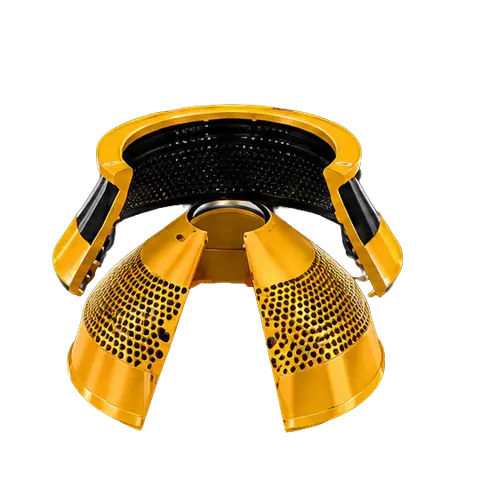
WEAR · Nº 01
Mantles & liners
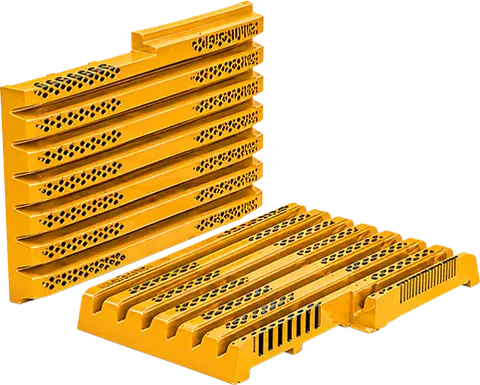
WEAR · Nº 02
Jaw plates
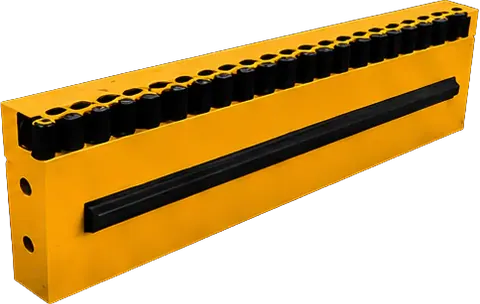
WEAR · Nº 03
Blow bars
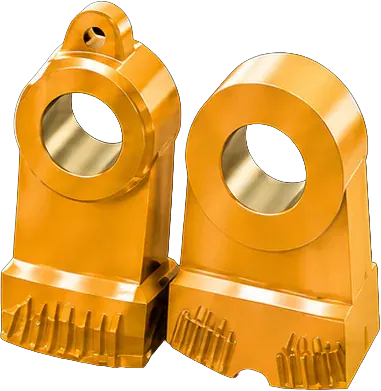
WEAR · Nº 04
Hammers
Frequently Asked Questions
How do the inserts actually work?
The insert is far harder than the metal around it, so it wears more slowly and stands slightly proud as the matrix recedes — which means the part keeps its working profile instead of rounding off. That is the whole mechanism, and it is why the gain is not only that the part lasts longer: a rounded liner or a rounded blow bar stops reducing material to the size it was set for long before it is worn out. Inserts go only in the zones that actually take the wear, so the rest of the casting keeps the toughness of the base alloy.
Ceramic, tungsten carbide or titanium carbide — which one?
Hardness and toughness pull in opposite directions, and how much impact the part takes decides where to sit between them. Ceramic is the hardest and the most brittle: the choice where wear is sliding abrasion and impact is low or well controlled. Tungsten carbide gives up a little hardness for markedly better toughness, which is why it is the usual answer on parts that take repeated blows, such as blow bars and hammers. Titanium carbide is harder than tungsten carbide and lighter, and holds its hardness better at temperature, but is less tough again. Tell us the machine, the feed and whether tramp metal reaches it, and we specify the insert as well as the alloy.
When does the premium pay back?
When changeout downtime costs more than the part. Inserted parts run roughly 40-60% more upfront. In abrasive duty they typically return 2-3 times the service life of standard manganese, and our high-chrome blow bars with ceramic and carbide inserts last up to 8 times longer than manganese or manganese-molybdenum bars. The case is strongest in high-silica, high-tonnage operations and weakest in soft rock, where a standard casting already lasts a long time and the premium never pays back.
Won't the inserts crack or come out?
They are cast into the part rather than fixed to it, and they sit below the original surface — the matrix wears back to expose them progressively instead of presenting them to the first impact. What ends an inserted part is the matrix eroding around the inserts, not inserts being thrown out of it. Where inserts do fail, it is nearly always the wrong insert for the duty: ceramic specified for work that needed the toughness of tungsten carbide. That is a specification decision, which is why we ask about tramp metal before quoting rather than after.
Which parts can be supplied with inserts?
The ones where a profile has to survive a whole campaign: mantles and concaves, jaw plates, blow bars and hammers are the standard set. Beyond those it becomes an engineering question rather than a catalogue one — send the part number or the drawing and we will tell you whether inserts make sense for it, including when they do not.
When is the Premium Line the wrong answer?
Three cases, and they are worth being honest about. Soft, low-silica rock, where standard manganese already outlasts the changeout interval you actually keep. Feed carrying regular tramp metal, because the hardness that resists abrasion is the same property that cracks under a loader tooth. And any operation where a changeout is cheap and quick — the premium buys back downtime, so where downtime is not the expensive part, it has nothing to sell you.