
01 · Crushers & Mills
Roll Crusher
Spare & Wear Parts
Smooth, corrugated and toothed roll shells in wear-resistant alloys, machined with a precision fit to the core — custom toothing per feed and product granulometry, designed for uniform torque transmission.
- Materials
- Wear-resistant alloys
- Shell types
- Smooth · Corrugated · Toothed — custom toothing per granulometry
- Quality
- Precision fit to core · machined to OEM tolerance
- OEM compatibility
- Available for the most common brands in the market
- Availability
- Ready-to-order or custom-engineered — Maximum Productivity · Longer Life · Special Application
Parts index
Complete parts list
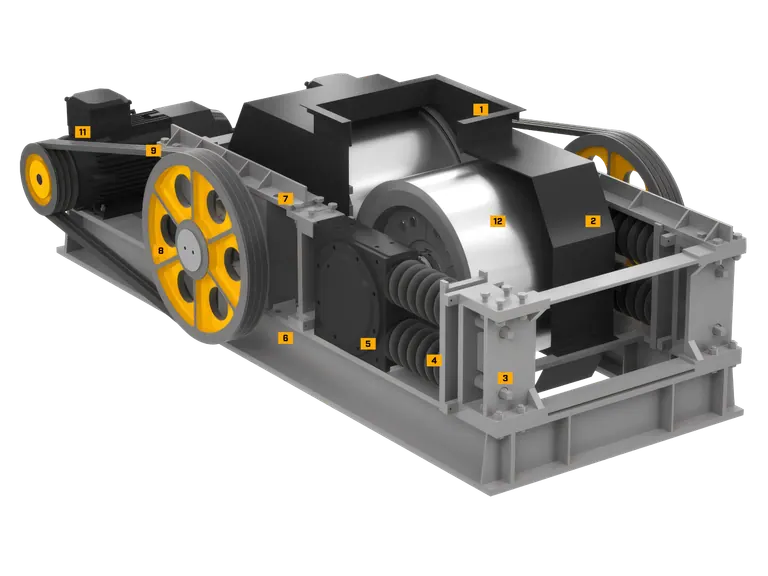
Spare parts — machined to OEM tolerance
- 01Feed inlet
- 02Protective cover
- 03Fixed frame
- 04Damper spring
- 05Bearing seat
- 06Main frame
- 07Base frame
- 08Belt pulley
- 09Belt
- 10Motor
- 11Motor pulley
Wear parts — wear-resistant alloys
- 12Roll shell
Wear parts
The part that does the work
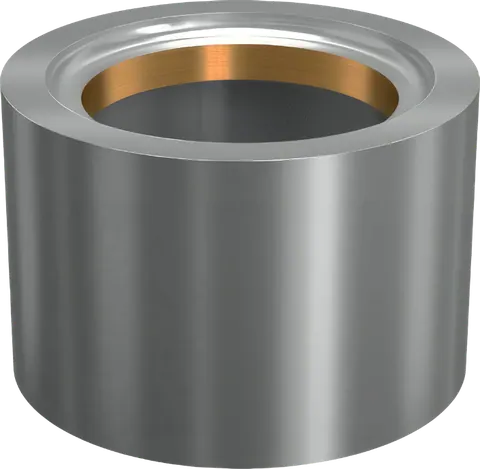
WEAR · Nº 12
Roll shell
Frequently Asked Questions
Smooth, corrugated or toothed — which shell, and what feed can each take?
Toothed shells bite: they suit brittle material like coal and salt, and accept the largest feed of the three — as a rule of thumb up to about a quarter of the roll diameter. Smooth shells crush by compression for a finer product on softer or more abrasive material, and need a much smaller feed, roughly a twentieth of the roll diameter, because there is nothing to grip a large lump with. Corrugated sits between them. Toothing is cut to the feed and the product you want, so tell us both rather than a shell part number.
Can the shell be replaced on the existing core, or do I need a whole new roll?
The shell is the wear part and the core is not — that is the point of a machined precision fit. A worn shell comes off and a new one goes on the same core, which is a fraction of the cost of a roll assembly and the reason shells are supplied separately. What matters is the fit: a shell that is not seated concentrically on its core transmits torque unevenly and will wear out of round no matter what alloy it is made of.
My rolls are wearing unevenly — grooves in the face, or one end faster than the other.
Both are feed distribution, not metallurgy. Material arriving down the middle instead of across the full width cuts a ring-shaped groove into the face, and the product size goes with it — everything through the groove is coarser than everything beside it. Feed biased to one end wears that end faster and leaves you a tapered gap, which is the same problem in a different direction. The fix is upstream: the feeder should span the full roll length.
How should I set and maintain the gap?
The gap is your product size, and unlike a jaw setting it moves as the shells wear rather than staying put. So it has to be reset against wear, not against the calendar — machines with hydraulic adjustment exist precisely to make that routine. Reset both rolls together: correcting one and leaving the other gives you a gap that is right at one point of rotation and wrong everywhere else.
How do I get more life out of the parts I already have?
Spread the feed across the full width — it is the single biggest lever here, and it costs nothing. Keep the feed within the size the shell profile can grip, because oversize rides on top of the rolls instead of being drawn in, polishing the face without being crushed. Reset the gap as the shells wear. And replace or re-machine shells in pairs, so the two rolls stay matched.