
01 · Crushers & Mills
Jaw Crusher
Spare & Wear Parts
Fixed and movable jaws, side liners and wedges in Mn14, Mn18 and Mn22 manganese steel — solution annealed and water quenched, with ultrasonic testing and physical-chemical certification cast by cast.
- Materials
- Mn14 / Mn18 / Mn22 manganese steel
- Tooth profiles
- Multiple profiles and pitches, matched to feed material and application
- Quality
- Solution annealed & water quenched · UT tested · Certified per cast
- OEM compatibility
- Metso · Sandvik · Terex Pegson · Telsmith · Kleemann · Trio · FAÇO · Furlan
- Availability
- Ready-to-order or custom-engineered — Maximum Productivity · Longer Life · Special Application
Parts index
Complete parts list
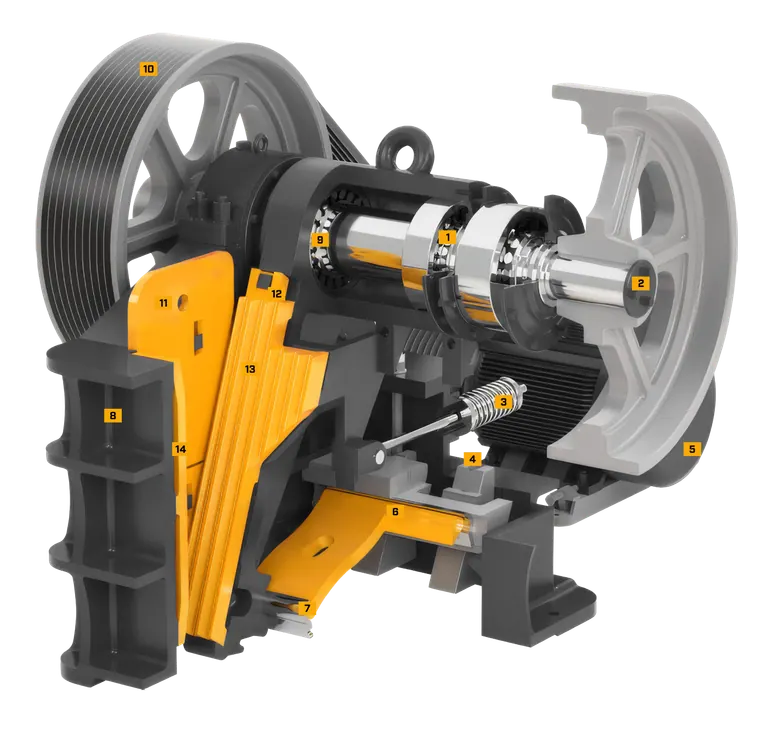
Spare parts — machined to OEM tolerance
- 01Main bearing
- 02Eccentric shaft
- 03Tension spring
- 04Tension rod
- 05Rear frame
- 06Toggle plate
- 07Toggle seat
- 08Front frame
- 09Pitman (movable jaw)
- 10Flywheel (pulley)
Wear parts — certified manganese steel
- 11Side plate
- 12Wedge
- 13Movable jaw
- 14Fixed jaw
Wear parts
The four parts that do the work
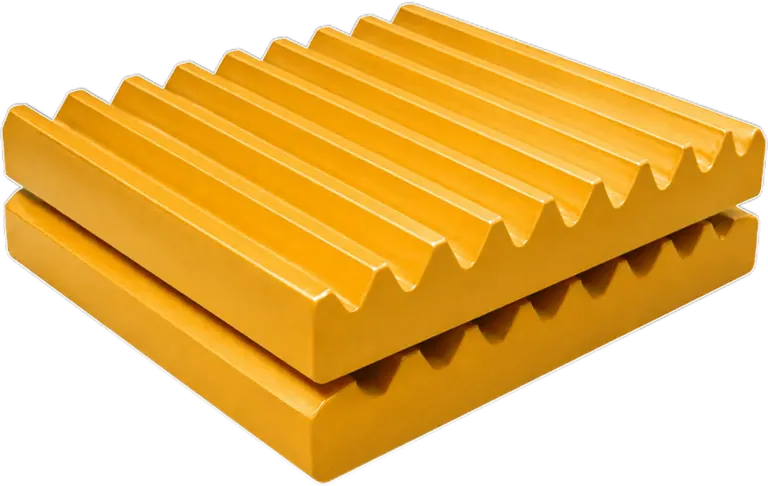
WEAR · Nº 14
Fixed jaw
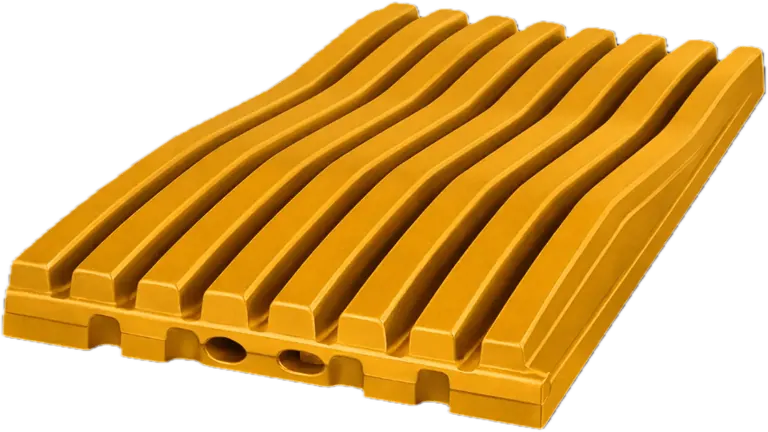
WEAR · Nº 13
Movable jaw
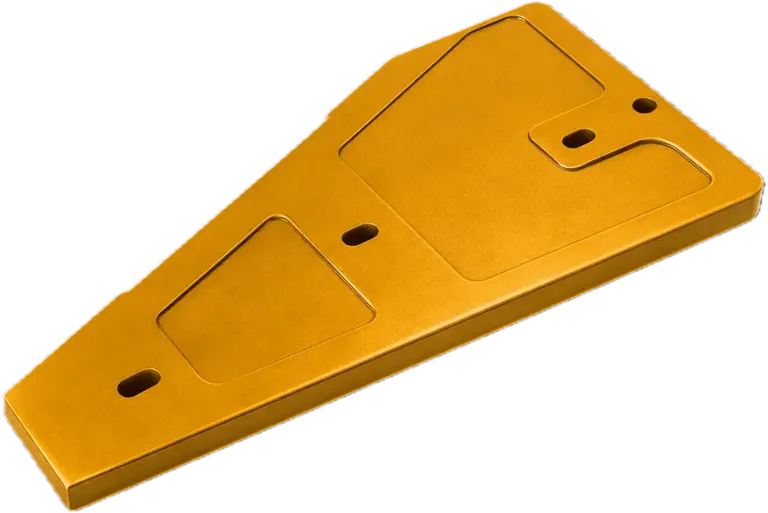
WEAR · Nº 11
Side plate
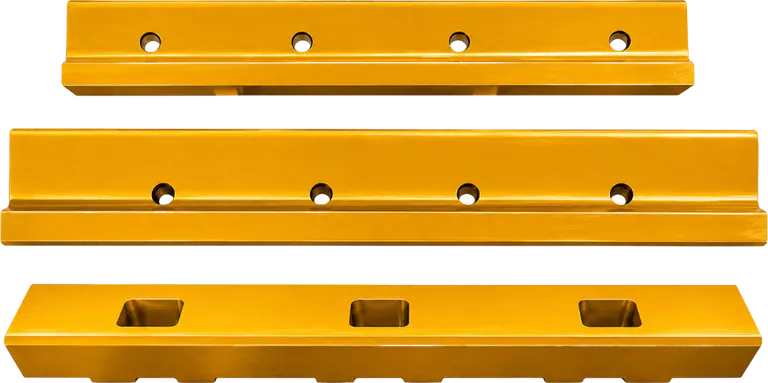
WEAR · Nº 12
Wedge
A range of tooth profiles and pitches is available, selected to match feed size, abrasiveness and crushing stage, always respecting OEM compatibility. Eccentric assembly and toggle mechanism spares (eccentric shaft, bearings, pitman, toggle plate and seat, springs and flywheel) are machined and balanced to OEM tolerance.
Premium Line — Ceramic & Carbide
When standard manganese isn't enough
Jaw plates in Mn18 and Mn22 reinforced with ceramic and tungsten/titanium carbide inserts embedded in the critical wear zones. The inserts, far harder than the metallic matrix, wear more slowly and keep the active profile through the whole campaign — multiplying service life in extremely abrasive applications.
Explore the Premium Line →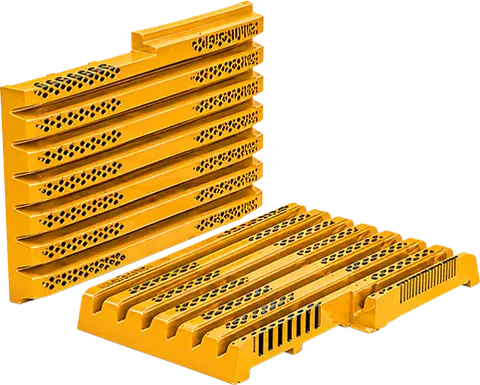
Compatibility
Equipment ranges we cover
We manufacture and supply spare and wear parts to suit the equipment below. Tell us the model and we will quote the exact part.
| Brand | Ranges & models |
|---|---|
| Metso |
C
C63 · C80 · C95 · C96 · C100 · C105 · C106 · C110 · C115 · C116 · C120 · C125 · C130 · C140 · C145 · C150 · C160 · C200 · C3054 · C3055
|
| Sandvik |
Jaw
CJ211 · CJ411 · CJ412 · CJ613 · CJ615 · CJ815
|
| Terex |
Pegson
Premiertrak 400X · Premiertrak 600
Finlay
J-960 · J-1170 · J-1480
|
| Kleemann |
Jaw
MC 110 EVO2 · MC 120 PRO
|
Also supported
Sandvik UJ · Sandvik QJ · Sandvik Extec · Sandvik JM · Sandvik Fintec · Terex Cedarapids JC / JS / JW · Telsmith · Trio CT · Atlas Copco Powercrusher · Kue-Ken Brown Lenox · McCloskey · Parker Plant · Pegson Premiertrak · Powerscreen · Svedala Jawmaster · Thyssenkrupp · Bergeaud VB · Goodwin Barsby · Osborn · CFBK · Hartl · Keestrack · FAÇO · Furlan BM · Furlan JC · Furlan RM · and more
Frequently Asked Questions
Which manganese grade should I specify for my application?
By impact energy, not by the highest number. Manganese castings start at roughly 200 HB and work-harden in service to 450-550 HB — but only where the application delivers enough impact to trigger it. Mn14 suits lower-impact duty and smaller machines; Mn18 is the workhorse for granite, basalt and general hard rock; Mn22 is for sustained high-impact primary crushing in large jaws. The counterintuitive part: a harder grade in the wrong duty wears faster, because it never work-hardens and abrades away as raw austenite. Tell us your feed and closed-side setting and we specify the grade.
When is the Premium Line with ceramic and carbide inserts worth the extra cost?
When changeout downtime costs more than the plate. Inserted parts run roughly 40-60% higher upfront and typically return 2-3 times the service life of standard manganese in abrasive duty, with replacement frequency down by more than 60%. That arithmetic works in high-silica, high-tonnage operations. It rarely works in soft limestone, where a standard Mn14 plate already lasts a long time and the premium never pays back.
On basalt or granite, what life increase should I expect from the Premium Line?
Expect the 2-3 times range, and understand why the baseline is short. Granite has a Bond abrasion index around 0.55 against limestone's 0.001-0.03, and basalt carries a Bond work index near 20 kWh/t. In that duty standard manganese typically runs 100-300 hours between changes. The same part in limestone can last 5-15 times longer — which is why the premium case is strong on granite and basalt and weak on soft rock.
My jaw plate cracked instead of wearing out. What went wrong?
Cracking is usually a specification problem rather than a casting defect: our manganese liners are tested cast by cast before they ship, so a manufacturing fault is the uncommon explanation. The most common cause is a grade too hard for the impact available — high-manganese grades need sustained impact to work-harden, and without it the austenite stays soft in bulk while the surface fatigues. The other frequent cause is seating: a plate that does not sit flat against the backing takes bending loads it was never designed for. Send us the failure photographs and the machine model and we will tell you which of the two it was.
How do I get more life out of the plates I already have?
Three levers, before you change anything you buy. Choke feed the chamber: running low or intermittent feed lets rock hammer the plates without a cushion. Reverse the plates — most designs can be turned 180 degrees once one end wears, close to doubling usable life. Match the tooth profile to the job: deep, widely spaced teeth for coarse primary feed; shallower, closer teeth for secondary duty and finer product. Plants that manage feed and settings deliberately report 30-50% more plate life than those that do not.