
01 · Crushers & Mills
Impact Crusher
Spare & Wear Parts
Blow bars, plates and liners in manganese steel, manganese-molybdenum and high chrome — selected by abrasiveness and feed size, certified cast by cast, with a ceramic and carbide insert option (Premium Line).
- Materials
- Manganese steel · Mn-Mo · high chrome; ceramic/carbide option
- Selection
- By abrasiveness and feed size of the material to be crushed
- Quality
- Physical-chemical certification per cast
- OEM compatibility
- Metso · Sandvik · FLSmidth/Fuller · Powerscreen · Rubblemaster
- Availability
- Ready-to-order or custom-engineered — Maximum Productivity · Longer Life · Special Application
Parts index
Complete parts list
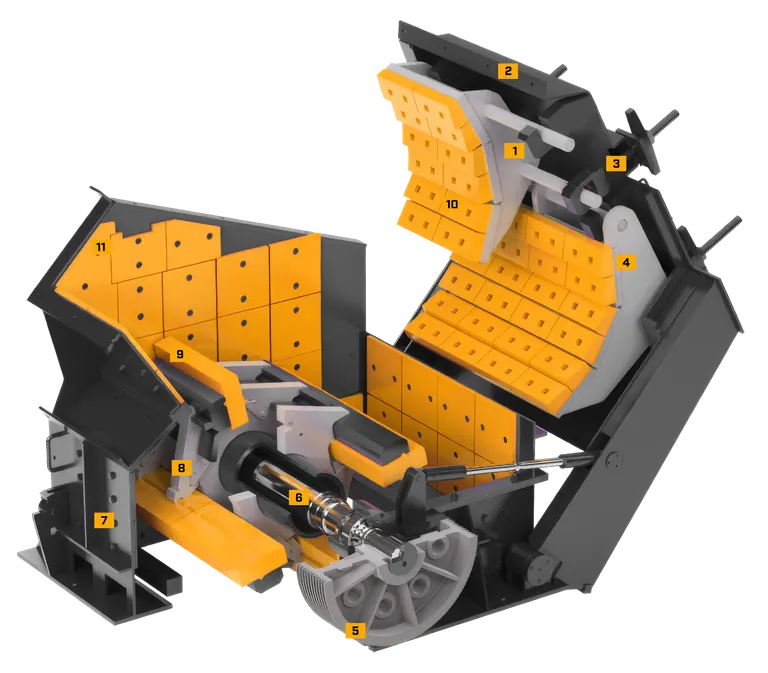
Spare parts — machined to OEM tolerance
- 01Upper impact frame
- 02Upper housing
- 03Tension rod
- 04Lower impact frame
- 05Pulley
- 06Main shaft
- 07Lower base
- 08Rotor frame
Wear parts — certified alloys
- 09Blow bar
- 10Impact plates
- 11Side liners
Wear parts
The parts that do the work
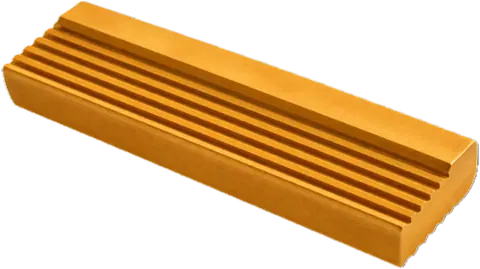
WEAR · Nº 09
Blow bar
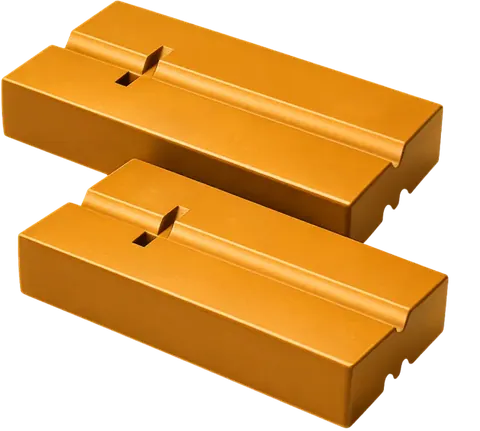
WEAR · Nº 10
Impact plates
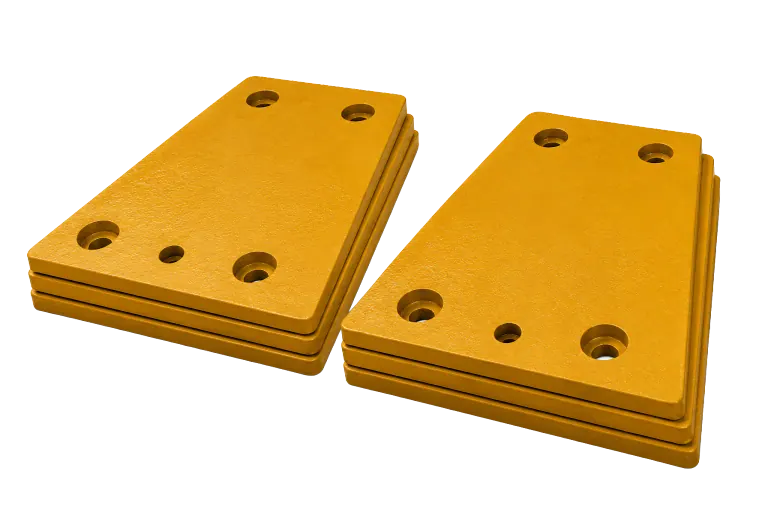
WEAR · Nº 11
Side liners
Premium Line — Ceramic & Carbide
When standard manganese or high-chrome alone aren't enough
Blow bars reinforced with ceramic and tungsten/titanium carbide inserts embedded in the critical wear zones. The inserts, far harder than the metallic matrix, wear more slowly and keep the active profile through the whole campaign — multiplying service life in extremely abrasive applications.
Explore the Premium Line →
Compatibility
Equipment ranges we cover
We manufacture and supply spare and wear parts to suit the equipment below. Tell us the model and we will quote the exact part.
| Brand | Ranges & models |
|---|---|
| Metso |
NP
NP1007 · NP1110 · NP1213 · NP1313 · NP1315 · NP1415 · NP1520 · NP1620 · NP2023 · NP15 · NP20
|
| Sandvik |
CI
CI711 · CI721 · CI731 · CI732
|
Also supported
Sandvik QI · Sandvik UI · Furlan OM · and more
Frequently Asked Questions
Which alloy should my blow bars be — manganese, Mn-Mo or high chrome?
Two variables decide it: how abrasive the feed is, and how much tramp metal reaches the rotor. Manganese work-hardens under impact and stays tough, so it survives large feed and the occasional loader tooth — the right answer for primary impact duty and for recycling where tramp iron cannot be fully controlled. High chrome is far harder and holds up in abrasive, low-impact work like asphalt and clean natural rock, but it is brittle: a single piece of tramp iron can fracture a bar. Manganese-molybdenum sits between the two, and is usually the correct choice when the feed is too abrasive for manganese but carries too much tramp metal for high chrome. Tell us the material and how clean the feed is and we specify the alloy.
Do I have to change all the blow bars at once?
As a weight-matched set, yes — this is the one rule on an impactor that is not negotiable. The rotor turns fast enough that a small weight difference between opposing bars becomes a large out-of-balance force, and the damage does not land on the bar: it goes into the bearings, the seals and the frame. Practice is to keep opposing bars within about half a kilogram, which means weighing them before installation and arranging them so the pairs match — not fitting them in the order they came out of the crate. Replacing one worn bar with one new one is how rotors get destroyed.
When is the Premium Line with ceramic and carbide inserts worth the extra cost?
When changeout downtime costs more than the bar. Our high-chrome blow bars with ceramic and tungsten/titanium carbide inserts last up to 8 times longer than manganese or manganese-molybdenum bars in abrasive duty, for roughly 40-60% more upfront. There is a second benefit on an impactor: the inserts hold the striking profile through the campaign, so reduction ratio and product shape stay closer to spec instead of drifting as the bars round off. One caution carries over from the alloy question above — the premium bar is high-chrome based, so the tramp-metal warning still applies. Keep the feed clean and it pays back fastest in high-silica, high-tonnage duty; in soft limestone a standard bar already lasts a long time.
My blow bar broke instead of wearing out. What went wrong?
On an impactor, breakage is usually the feed rather than the casting: our parts are certified physical-chemically cast by cast before they ship, so a manufacturing fault is the uncommon explanation. The most common cause is tramp metal meeting a hard, brittle alloy — a loader tooth or a length of rebar will fracture a high-chrome bar that would only have dented a manganese one. The second is a bar that was not properly seated and clamped in the rotor, so it carried bending loads instead of transmitting the blow. If you are breaking high-chrome bars regularly, the answer is usually a magnet and a metal detector upstream, or a step down to Mn-Mo — not a harder bar. Send us the pieces and the machine model.
What do rotor speed and the apron setting actually change?
Rotor speed sets how hard each blow lands; the aprons set how far material travels before it leaves. Faster and closer gives a finer, better-shaped product and more of it — and takes it out of the wear parts, because every one of those is also a wear variable. What operators most often miss is that the setting drifts on its own: as the bars wear back the gap opens, product creeps coarser, and the reduction you set on day one is not the reduction you have in week six. Reset the aprons against bar wear, not against the calendar.
How do I get more life out of the parts I already have?
Turn the bars before you replace them — most designs are symmetrical and can be reversed once the leading edge is worn, which is close to a second life for the price of a changeout. Keep tramp metal out: a magnet and a detector protect the bars, the plates and the rotor at once. Feed evenly across the chamber width rather than down one side, so bars wear along their whole length instead of in a band. And reset the apron gap as the bars wear, both to hold product size and to stop material battering a wider gap than the machine was set for.