
01 · Crushers & Mills
Cone Crusher
Spare & Wear Parts
Mantles and concaves in Mn14, Mn18 and Mn22 manganese steel, in five chamber profiles — solution annealed and water quenched, with ultrasonic testing and physical-chemical certification cast by cast.
- Materials
- Mn14 / Mn18 / Mn22 manganese steel
- Chamber profiles
- Extra coarse · Coarse · Medium · Fine · Extra fine — interchangeable direct replacement
- Quality
- Solution annealed & water quenched · UT tested · Certified per cast
- OEM compatibility
- Metso/Nordberg HP·GP·MP · Sandvik CH/CS · Symons · FAÇO · Furlan · Telsmith · Terex · Kleemann
- Availability
- Ready-to-order or custom-engineered — Maximum Productivity · Longer Life · Special Application
Parts index
Complete parts list
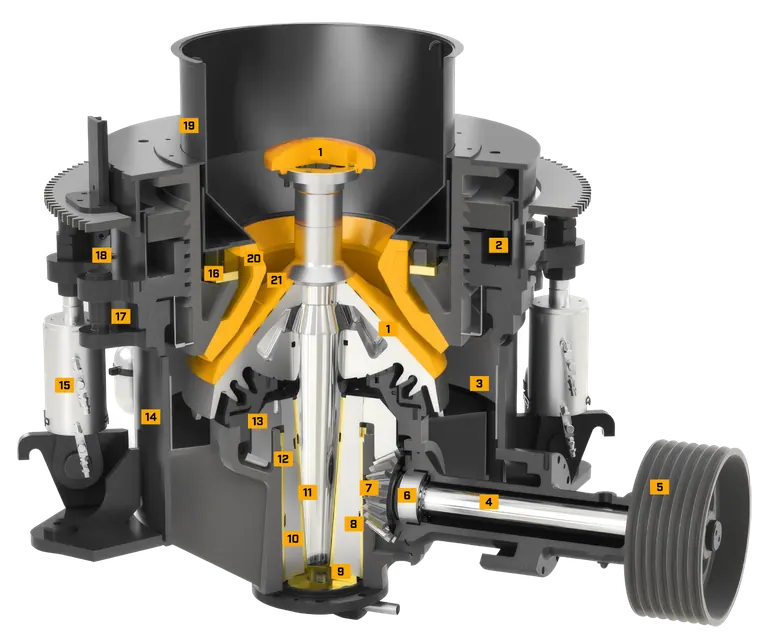
Spare parts — machined to OEM tolerance
- 01Distributor plate
- 02Locking ring
- 03Inner liner
- 04Drive shaft
- 05Pulley
- 06Drive shaft bearing
- 07Pinion
- 08Outer eccentric bushing
- 09Upper thrust plate
- 10Inner eccentric bushing
- 11Main shaft
- 12Eccentric bushing
- 13Gear (corona)
- 14Lower frame
- 15Hydraulic cylinder
- 16Adapter ring
- 17Lower adjustment sleeve
- 18Upper adjustment sleeve
- 19Feed hopper
Wear parts — certified manganese steel
- 20Concave ring
- 21Mantle
Wear parts
The parts that do the work
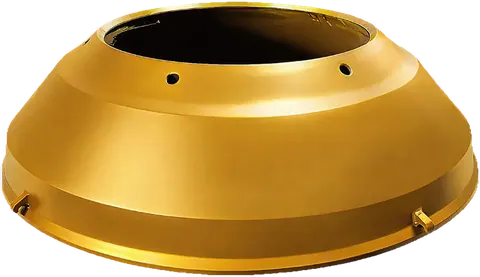
WEAR · Nº 21
Mantle
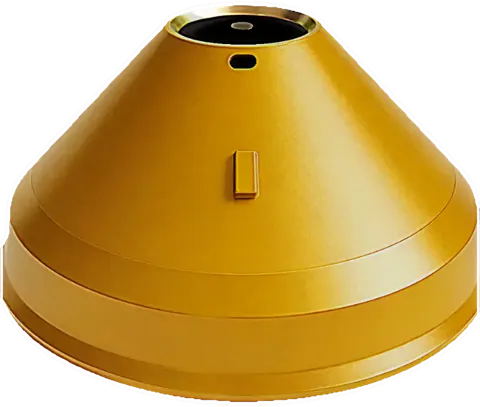
WEAR · Nº 21
Mantle — example #2
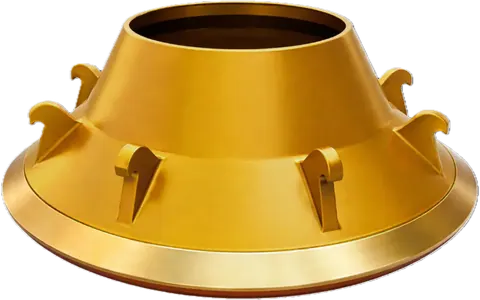
WEAR · Nº 20
Concave ring
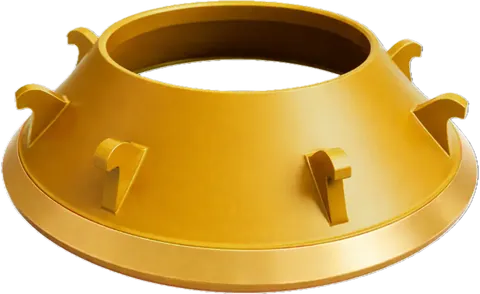
WEAR · Nº 20
Concave ring — example #2
Premium Line — Ceramic & Carbide
When standard manganese isn't enough
Mantles and concaves reinforced with ceramic and tungsten/titanium carbide inserts embedded in the critical wear zones. The inserts, far harder than the metallic matrix, wear more slowly and keep the chamber profile through the whole campaign — multiplying service life in extremely abrasive applications.
Explore the Premium Line →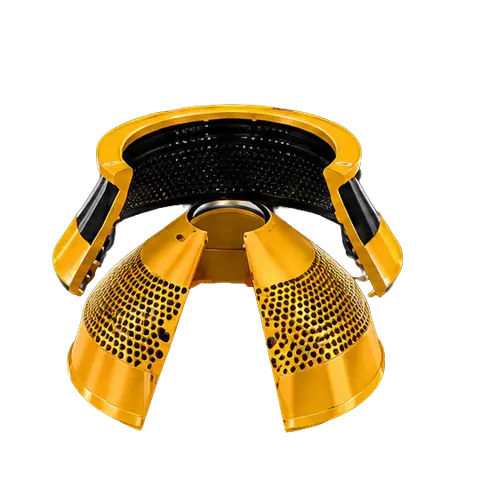
Compatibility
Equipment ranges we cover
We manufacture and supply spare and wear parts to suit the equipment below. Tell us the model and we will quote the exact part.
| Brand | Ranges & models |
|---|---|
| Metso |
HP
HP200 · HP300 · HP400 · HP500 · HP700 · HP800 · HP900 · HP3 · HP4 · HP5 · HP6
MP
MP800 · MP1000 · MP1250 · MP2500
GP
GP11 · GP100 · GP100S · GP200 · GP200S · GP220 · GP250 · GP300 · GP300S · GP500 · GP500S · GP550
Symons
2ft · 3ft · 4ft · 4¼ft · 5½ft · 7ft
|
| Sandvik |
H / S
H2000 · H3000 · H4000 · H6000 · H2800 · H3800 · H4800 · H6800 · H8800 · S2000 · S3000 · S4000 · S6000 · S2800 · S3800 · S4800 · S6800
CH / CS
CH420 · CH430 · CH440 · CH540 · CH550 · CH660 · CH870 · CH880 · CH890 · CH895 · CS420 · CS430 · CS440 · CS660 · CH840i · CH890i
|
| Terex |
El-Jay
RC45 · RC54
Cedarapids
MVP280X · MVP380X · MVP450X
TC
TC1150
|
| Telsmith |
Gyrasphere
SBS 44 · SBX 52 · T300 · T400
|
| Kleemann |
MCO
MCO9 · MCO 90i EVO2 · MCO 110 PRO
|
Also supported
Sandvik Extec X SBS · Terex Finlay · Terex TGS · Atlas Copco PC · FLSmidth Raptor · Kue-Ken CT · McCloskey · Parker · Pegson Autocone · Pegson Automax · Powerscreen Maxtrak · Svedala Hydrocone · Svedala Superior · Thyssenkrupp Kubria · Nordberg Omnicone · Nordberg Symons · FAÇO · Furlan CC · and more
Frequently Asked Questions
Which manganese grade should I specify for my mantle and concave?
By impact energy, not by the highest number. Manganese castings start at roughly 200 HB and work-harden in service to 450-550 HB — but only where the chamber delivers enough load to trigger it, and how far they harden depends on the chemistry, the grain size and the ore itself, not on the grade alone. Mn14 suits lower-impact duty and smaller machines; Mn18 is the workhorse for granite, basalt and general hard rock; Mn22 is for the most demanding high-load duty in large cones. The counterintuitive part: a harder grade in the wrong duty wears faster, because it never work-hardens and abrades away as raw austenite. Tell us your feed and closed-side setting and we specify the grade.
Which chamber profile should I run — extra coarse through extra fine?
The profile has to match the feed at the top and the product at the bottom, and getting it wrong is expensive: the fit between mantle and concave, combined with the eccentric throw, can cost up to half the liner life on its own. Coarse and extra coarse profiles take a coarse, irregular feed in a deep cavity; fine and extra fine suit a smaller, well-graded feed and hold a more uniform product. The tell is in the wear pattern — feed too coarse for the chamber wears the top of the liners first, feed too fine for the opening wears the bottom.
Does eccentric speed change how fast the liners wear?
More than almost anything else you control. In discrete-element studies of cone chambers, head rotating speed is the single most influential variable on liner wear, ahead of the throw. Raising the speed puts more crushing cycles per minute through the same manganese: throughput rises and product size falls, but every extra cycle is another loading event on the liner. Speed and throw are worth tuning together rather than separately — a larger throw at lower speed and a smaller throw at higher speed can produce similar tonnage with very different liner life.
When is the Premium Line with ceramic and carbide inserts worth the extra cost?
When changeout downtime costs more than the liner. Inserted parts run roughly 40-60% higher upfront and typically return 2-3 times the service life of standard manganese in abrasive duty. In a cone there is a second benefit beyond life: the inserts hold the chamber profile through the campaign, so product gradation stays closer to spec instead of drifting as the liners open up. That case is strong in high-silica, high-tonnage duty and weak in soft limestone, where standard manganese already lasts a long time.
My mantle cracked instead of wearing out. What went wrong?
Cracking is usually a specification or installation problem rather than a casting defect: our manganese liners are solution annealed, water quenched, ultrasonically tested and certified cast by cast before they ship, so a manufacturing fault is the uncommon explanation. The most common cause is a grade too hard for the impact available — high-manganese grades need sustained load to work-harden, and without it the surface fatigues while the bulk stays soft. In very hard, brittle feed the opposite occurs: impact outruns the work-hardening and cracks the liner. The third cause is backing and seating — a liner that isn't fully supported takes bending loads it was never designed for. Send us the failure photographs and the machine model.
How do I get more life out of the liners I already have?
Feed management, mostly, and it costs nothing. Choke feed the chamber — a choke-fed cone wears its liners evenly from top to bottom, an intermittently fed one does not. Centre the feed: an off-centre feed loads one side of the chamber and gives you uneven wear, ring bounce and poor particle shape at once. Feed a well-graded material with no large gaps in the gradation, so the load spreads through the whole chamber. And change the mantle and concave as a set — a new liner run against a worn mate never seats to the profile it was cast for.