
11 · Low Friction
PE-UHMW
Plastic Plates
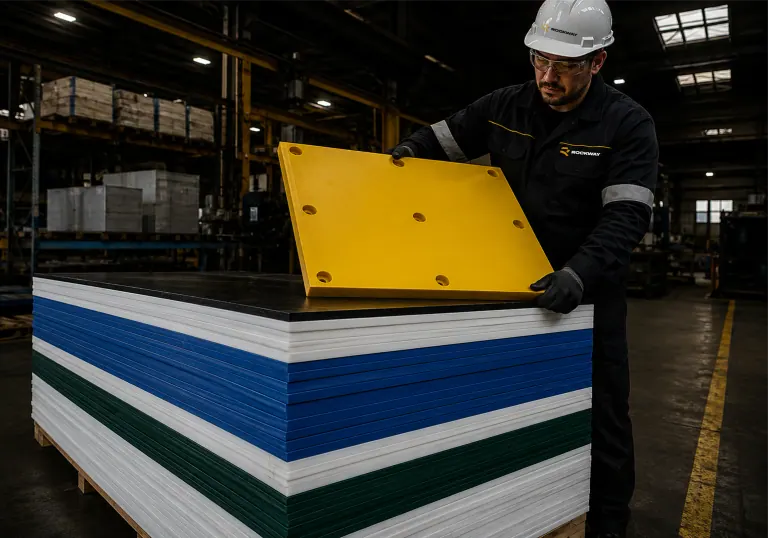
An extremely low coefficient of friction and high resistance to sliding abrasion: PE-UHMW optimizes material flow and eliminates build-up in transport, discharge and storage systems — fixed on with weld-on washers or bolts, and far quieter than steel.
- Material
- PE-UHMW · molecular weight > 7,000,000 g/mol
- Friction
- Dynamic coefficient 0.10–0.20 against dry steel
- Service range
- −200 °C to +90 °C · ≈0% moisture absorption · high chemical resistance
- Installation
- Weld-on fixing washers or bolt-on — no drilling through the structure, fully replaceable
- Availability
- Ready-to-order or custom-engineered — Maximum Productivity · Longer Life · Special Application
The PE-UHMW line
Material flows. Nothing sticks.
Wet, ultra-fine, sticky or frozen material stops sliding on steel — it packs into corners, bridges over discharge openings and chokes transfer points. PE-UHMW's near-zero surface adhesion keeps material moving at lower chute angles, eliminating build-up, hang-ups and the downtime spent cleaning them.
01 · Liners
PE-UHMW liner sheets
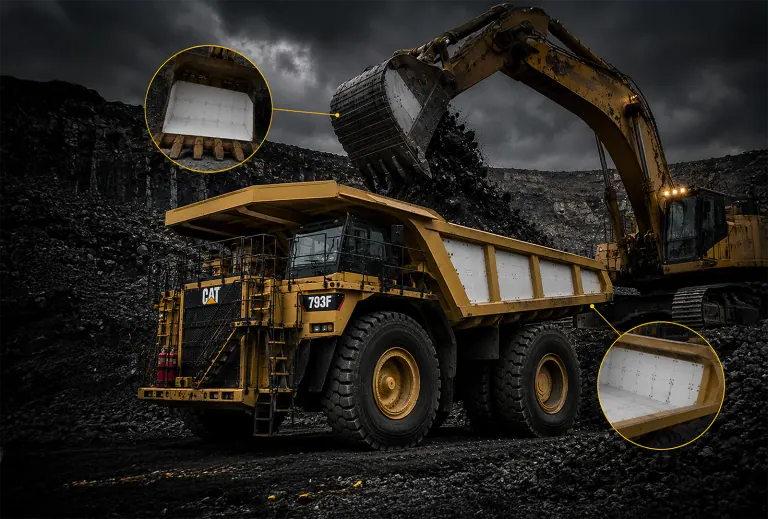
Fixed over the existing steel structure — no drilling through the base plate — PE-UHMW liners give chutes, hoppers and silos a permanently slick working face: material slides instead of packing, discharge stays constant even with wet fines and clay — no vibrators, no hammer-rash, no cleaning shifts.
- ·Chute and transfer-point liners — lower chute angles without plugging
- ·Hopper, bin and silo linings — mass flow instead of rat-holing
- ·Truck and dump-body liners — full loads discharge clean, less carry-back
- ·Skirts, scrapers, wear strips, guide rails, feed trays and cyclone linings
02 · Mining trucks
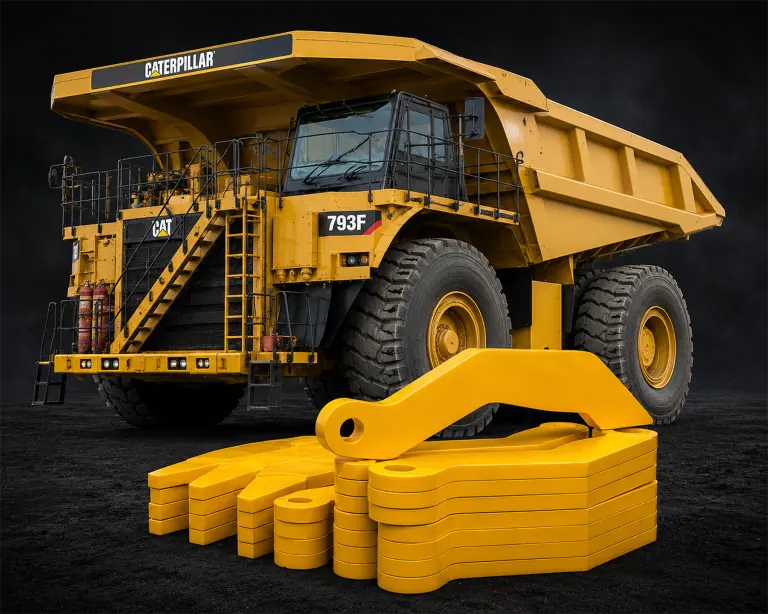
Rock ejectors
Rock wedged between the rear dual tires cuts sidewalls, causes punctures — and a single OTR tire runs tens of thousands of dollars. The ejector arm rides between the duals and flicks rock out before it can lodge.
- ·Prevents cuts, punctures and premature scrapping of OTR tires
- ·Flexes on impact — no damage to tire, rim or suspension
- ·Self-cleaning in mud, clay and packed fines — sizes per axle configuration
Frequently Asked Questions
What actually separates one UHMW sheet from another?
Molecular weight, more than anything else on the datasheet. ASTM D4020 sets the floor for a material to be called UHMW at 3.1 million g/mol, and much of what is sold as UHMW sits just above that line — or is HMWPE below it, which is a different, cheaper material wearing a similar name. Sliding abrasion resistance climbs with molecular weight, which is why our sheets are specified above 7 million. When comparing quotes, ask for the molecular weight in g/mol and the standard it is measured against. A supplier who will not state it is telling you something.
Virgin or reprocessed — is reprocessed acceptable?
Sometimes, and it should be priced accordingly. Reprocessed sheet is made from regrind of virgin offcut; its molecular weight ends up lower and more variable, so abrasion resistance and impact toughness drop a little, and it typically sells for 15-25% less. For a low-duty chute liner that is a legitimate saving. For a high-wear transfer point it is a false economy, because you pay the changeout labour twice. What you should not accept is reprocessed material sold as virgin — which is why the molecular weight figure matters more than the word on the invoice.
Is a higher molecular weight always better?
For sliding abrasion, higher is better — but only if the sheet is properly consolidated. Very high molecular weight polyethylene cannot be melt-extruded like ordinary plastic; it has to be compression-moulded or ram-extruded, and if the sintering is poor the sheet carries internal voids that undo the benefit entirely. So the specification that matters is molecular weight and consolidation quality together, never molecular weight alone. Our sheets are specified on both counts: above 7 million g/mol, higher than most sheet on the market, and sintered under a controlled process that carries that molecular weight right through the section rather than only at the surface.
What are the temperature and load limits?
Continuous service runs to about +90 °C and all the way down to −200 °C without embrittlement, which is why it suits cold climates where steel liners frost up. The limitation is not usually heat but creep: under sustained mechanical load PE-UHMW deforms slowly and permanently. It is a wear surface, not a structural member — it should be backed by the structure and never asked to carry the load itself.
How should the sheets be fixed?
Weld-on fixing washers or bolt-on (stud weld), without drilling through the structure — the sheet is fully replaceable and the structure stays intact. The detail that matters is allowing for thermal movement: PE-UHMW expands and contracts far more than the steel behind it, so fixings that clamp it rigidly at every point will make it buckle. Fix it so it can move, and it will lie flat for its whole life.
When is UHMW the wrong choice?
Three cases, and they are worth being honest about. Above roughly 90 °C it softens and loses its wear properties. Under heavy direct impact from sharp rock it will gouge, where a steel or ceramic liner would not — its strength is sliding abrasion and flow, not blunt force. And anywhere it would carry structural load, because of creep. Where the problem is material sticking, bridging or refusing to flow, it is usually the best answer available; where the problem is being hit hard, it usually is not.